User Login


ShareThis

By A Web Design

shotimoo - Simple notifier


Ice Dams

Ice Dams
Tuesday, 29 November 2011 20:27

The causes, removal and prevention of roof ice damming.

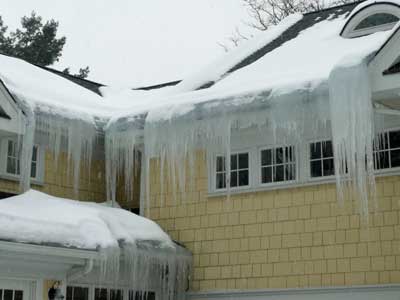
Ice dams are large areas of ice that build up near the lower edge of your roof when melting snow freezes as it contacts the cold edge of your roof and rain gutter.

The buildup of ice blocks subsequent snow melt from running off the roof and allows water to pool and then leak under your existing shingles and into your house.

Symptoms include, major icicles forming on the gutter, icicles behind the gutter, icicles hanging from the soffit vents, and leaks and stains along the interior and exterior ceiling and walls. Ice dam leaks can also ruin your roof sheathing, rot the gutter board and soffit, and loosen the gutter, shingle, and drip edge fasteners. Ice dam caused by lack of insulation.


What causes ice dams?

Warming of the snow on a roof when the outside air temperature is below freezing is the cause of the ice dam.

What causes the snow to melt on the roof? Now that is the million dollar question.

There are many reasons.

From the interior, warm air in the attic can warm the roof sheathing and melt the snow from below. This can be from either insufficient or poorly installed insulation, or air leaking from the interior living space.

Insufficient natural attic ventilation can also contribute to ice dams when warm air that accumulates  in the attic is not allowed to readily escape.

From the exterior, warmer temperatures, radiation from the sun and solar radiation reflecting off adjoining building components will cause the snow to melt. There is also heat gain along the gable attic walls and from south and west facing walls.


Are ice dams new?

Ice dams are not new, but they are more prevalent. Before the price of heating fuels began to rise, ice dams were not such a large problem. Heat was cheap and there was not much importance given to keeping the heat in the house. There was little if any insulation in the attic which meant the heat went straight into the attic. The excess heat melted all the snow on the roof and was warm enough to keep the snow melt from re freezing at night. Along with better building methods such as larger roof overhangs, this kept the ice dam leaking to a minimum.


Preventing Ice Dams

Ice dams can often, but not always, be prevented. In many cases either due to economics or climate conditions, they can only be reduced and maintained. For example, a house built with cathedral ceilings with little rafter space for sufficient insulation and venting would require extensive re construction to accommodate these preventive measures. 

to be continued...

Last Updated on Thursday, 29 December 2011 17:01
 

Metal Roof Ice Dam

Ice Dams
Tuesday, 24 January 2012 14:04

Will a metal roof prevent ice dams?


A metal roof can reduce the leaking that occurs due to ice damming but it will not prevent ice dams from forming. In some cases it may add to the ice dam formation. A metal roof may warm up faster from solar heat gain  than an asphalt roof creating more snow melt flowing to the lower edge of the roof where it can freeze.

The leaking is reduced by having fewer points of entry for pooling water to backup into the roof. Asphalt shingles as well as wood, tile and slate, have multiple nail holes and gaps between them. Metal roofs need fewer fasteners and are usually fabricated in large sheets reducing the available areas for leaks.

A properly installed traditional double locked standing seam roof will have fewer points of entry for water backup than a snap lock, or exposed fastener metal roof. A metal shingle roof that is installed with interlocking joints will also have reduced points of entry for water backup.

Last Updated on Tuesday, 24 January 2012 21:31
 

Roof Drip Edge

Roofing How To
Saturday, 03 September 2011 00:04


Should you install drip edge flashing on all edges of your roof?


     The importance of drip edge installation depends mostly on  the type of wood used for the roof deck and how much water is likely to come into contact with that wood. Proper drip edge installation can prevent soffit and roof deck damage.

On old houses, drip edge installation may not be needed.

On newer houses built with plywood and osb(oriented strand board) roof decking, it should probably be installed.


Many old houses were built with solid wood for the roof deck and trim moldings. The old solid wood, if exposed to water for short periods such as wind driven rains, was able to absorb that water, and then release the moisture over time and dry without any ill effects. 

Plywood, made up of layers of wood veneer and glue,  and osb or particle board which is chips of wood glued and pressed together, if exposed to water will quickly deteriorate. The glues will break down and the thin layers of wood will swell, buckle and eventually fall apart.


The picture below is of a slate roof without eave or rake drip edge flashings. The poor quality slate shingles are being replaced with high quality (s1) slate shingles and copper flashings.

The wood roof decking on this house is approximately 60 years old and in great shape. There are signs that water has gotten under the shingle edge and stained the wood, but the wood is solid and ready for another layer of slate shingles. The leakage could have been from ice damming, broken slate shingles, or the poorly installed replacement rain gutters. Or a combination of the above.

Roof eave without drip edge flashing

The gable ends of the roof are also without drip edge flashing. This picture shows one of the main roof gable dormers with crown molding and slate shingles.

The overhanging slate shingles protect the roof deck and solid wood moldings from most rain, but the gap between them can allow wind driven rain to reach the roof deck and the backside of the crown molding.

Roof dormer without drip edge flashing


The wood decking under the slate shows no signs of deterioration even with the lack of drip edge flashing.  Even more remarkable as the roof boards have been cut at an angle,  to accomodate the beveled rake trim molding, leaving a thin edge at the top side. (you won't see that kind of attention to detail on most new houses)

Slate roof wood decking with no drip edge

For old houses with solid wood decking and trim

  • install ice and water shield at the eaves if there is a history or possibility of ice dams forming
  • install a good quality roof underlayment, preferably one that breathes, 
  • install the shingles approximately 1- 1 1/2"  past the roof trim at the eaves and 1" past the roof trim at the rake edge
  • drip edge flashing would be optional,  depending on the style and trim it may be asthetically pleasing or may detract from the architectural style of the house.


For newer houses with plywood or osb roof decking

  • install ice and water shield at the eaves if there is a history or possibility of ice dams forming
  • install drip edge flashing at eaves and rakes
  • install good quality roof underlayment, over the eave drip edge and under the rake drip edge
  • install the shingles approximately 1/4 " - 1/2" past the drip edge flashing at both the eaves and the rake edge


Last Updated on Tuesday, 13 September 2011 01:49
 

Drip Edge

Roofing How To
Thursday, 24 February 2011 22:35

Proper  practices for the installation of roof drip edge flashing.

Roofing drip edge or cap is the metal flashing that covers the wood decking at the edge of a roof and supports the roof shingles.Drip edge flashing on roof rake
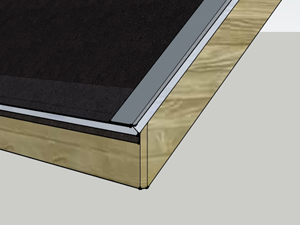
 It is intended to prevent water from contacting and damaging the roof decking, prevent the roof shingles from drooping over the roof edge, and improve the appearance of the roof line.


Last Updated on Tuesday, 13 September 2011 01:53
 

Drip edge and water leaking behind gutter.

Roofing How To
Saturday, 12 March 2011 00:23

Stop rain water from dripping between the gutter and fascia board.


Drip edge flashing is used at the eave or edge of the roof to protect the fascia board from water damage and rot.  

Drip edge behind gutter

Unfortunately it is often installed wrong.


Your first indication of drip edging installed wrong is the rain water that is dripping from under the rain gutter, and the dirty streaks and stains across the gutter board. If the gutter itself is loose or buckled from improper installation, there may also be debris, ( leaves twigs and such ) sticking out from under the gutter.

Rain water splashing up from the gutter will seep in between the drip edge flashing and the rear flange of the gutter and drain down the gutter board.

Besides the ugly stains on the gutter board, water that gets behind the rain gutter can lead to peeling paint, rusted nails and fasteners and rotting wood.

You can resolve this problem in two ways. One, have your roofer remove and re install the drip edge over the gutter. Or, have a gutter specialist remove and re install the rain gutter behind the drip edge flashing.


Gutter installed right behind drip edge

Last Updated on Saturday, 12 March 2011 18:28
 
«StartPrev12NextEnd»

Page 1 of 2
Copyright © 2012 Roofing Contractor Review. All Rights Reserved.
Joomla! is Free Software released under the GNU/GPL License.